Direct answer: what makes a PCBA kit ready?
A kit is ready for the specified build only when the released BOM and work order match the accepted material identity and quantity, applicable handling status is known, and every shortage or deviation has an authorized disposition. Ordered, shipped and physically received quantities are not interchangeable with accepted, usable stock. A pilot may proceed with a documented restriction; that is not a blanket release for repeat production.
This page covers the execution handoff from purchase order to material release. For comparing suppliers and quotation assumptions before purchase, use the component sourcing evidence guide. For deciding whether the customer or EMS partner buys each BOM line, use the turnkey, consigned and mixed sourcing guide.
Start with a controlled receiving baseline
Give receiving and production one approved product configuration. A purchasing spreadsheet without the assembly revision, orderable manufacturer part number and authorized alternatives cannot by itself establish which component belongs in a build. Agree who can approve a different source or part before a shortage occurs.
| Input or record | Check at receipt | Decision it supports |
|---|---|---|
| Released BOM and work order | Assembly revision, line number, planned quantity and approved part or alternate | Which configuration the material may serve |
| Purchase or consignment record | Source, ordered quantity, shipment identity and ownership route | Whether the delivery matches the authorized supply route |
| Supplier label and packaging | Manufacturer part, package, lot or date information where required, seal and visible condition | Accept, investigate or segregate the delivery |
| Handling instruction | Supplier-specific moisture and ESD requirements, exposure information and storage status | Whether material can be stored, opened or issued under the agreed plan |
| Inspection and exception record | Required checks, result, quantity accepted, quantity held and approver | Usable balance and next action |
Where the customer supplies a kit, ask for the same identity and handling information. Receipt of a carton confirms delivery, not acceptance of every item inside it. The design transfer package explains how the approved BOM and assembly data stay together.
Run the receiving check without losing material status
1. Match identity before counting availability
Compare the supplier label and orderable part with the purchase record and released BOM. Check package or variant suffixes where they affect the approved design. Record lot information to the level required by the product and agreed traceability plan; do not promise unit-level traceability when only lot-level data exists.
2. Keep packaging and exposure evidence with sensitive parts
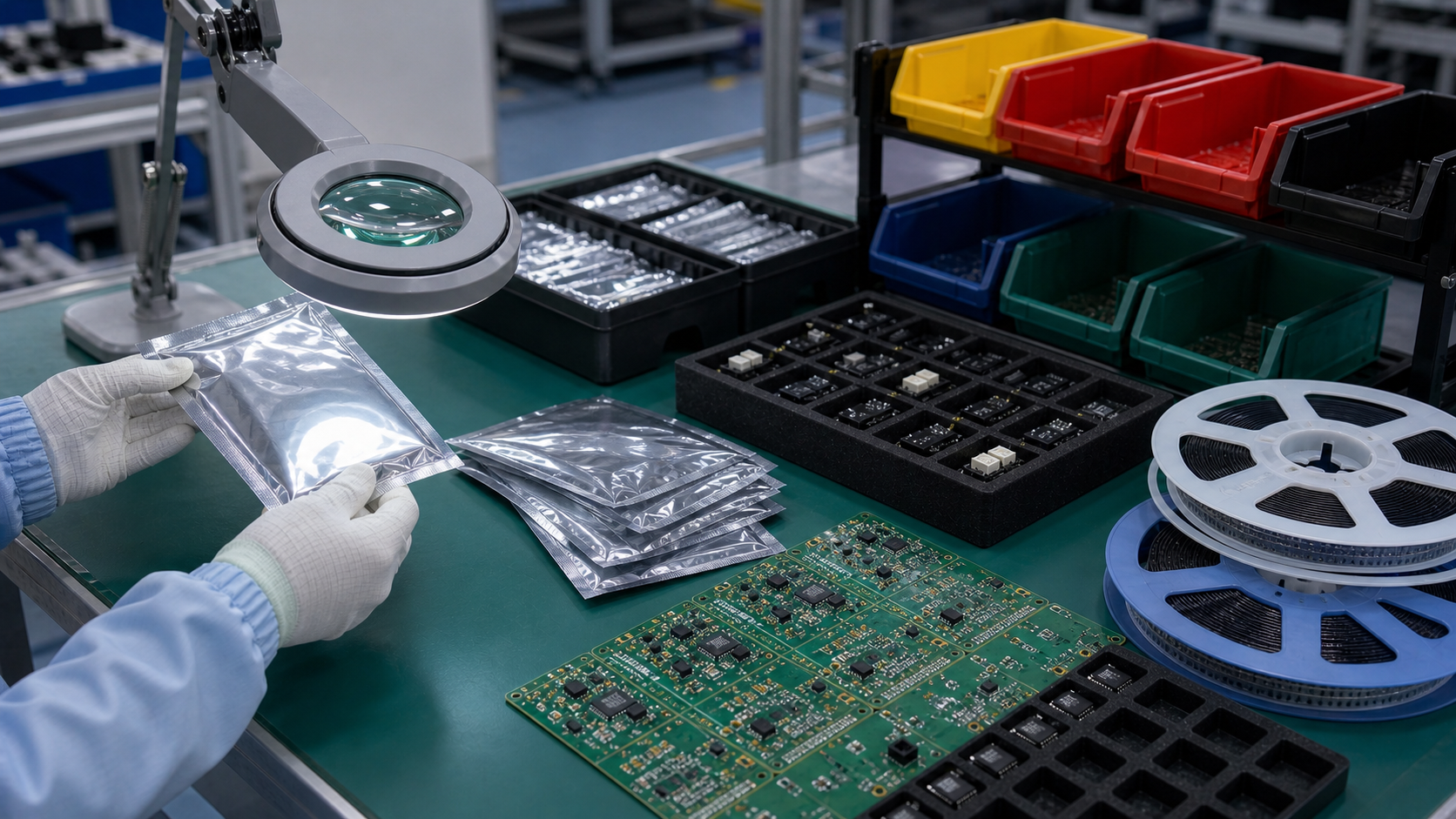
For moisture-sensitive surface-mount devices, use the component supplier’s classification, label and instructions to decide whether the bag may be opened and how exposure is tracked. IPC/JEDEC J-STD-033D describes handling, packing, shipping and use of classified moisture/reflow-sensitive devices; the exact action depends on the part and its history. Texas Instruments’ MSL application report explains why floor life begins after dry-pack opening. This article does not assign a universal floor-life or bake cycle to an unidentified component.
Keep ESD-sensitive material in suitable protective packaging until an agreed controlled handling step. The EOS/ESD Association’s S20.20 overview describes an ESD control program; it does not certify a particular factory or this shipment. A broken seal, missing label or uncertain exposure history is a question to resolve, not an automatic release.
3. Record inspection and segregate exceptions
Apply the inspection plan appropriate to the part and source risk. A visual check can reveal an identity mismatch or damage, but it cannot establish electrical authenticity or detect every counterfeit. Confirm an approved channel where the buyer requires one; Analog Devices’ authorized-distributor information illustrates why source evidence matters for its own products. Do not generalize that page into a guarantee for every component brand.
Give rejected or uncertain quantities a distinct hold status. Preserve the original label and receiving evidence, name the decision owner, and document whether the next step is supplier clarification, added inspection, replacement or engineering review. Purchasing must not silently approve a technical substitution.
Calculate usable kit balance, not just purchase-order balance
For each BOM line, calculate the build need from the approved quantity per assembly and planned build quantity, then add only the project-approved setup or process allowance. Compare that need with accepted material available for this work order after reservations and holds. Do not apply a universal attrition percentage or count material still in transit as released stock.
Illustrative arithmetic, not a Keep Best project: 100 boards require two connectors each, so the base need is 200. If 210 connectors arrive but 20 are held pending identification, only 190 are accepted. The kit is short by at least 10 before any approved allowance. Releasing the work order because 210 were received would conceal the shortage.
| Exception | Hold or review decision | Evidence before release |
|---|---|---|
| Wrong or incomplete part identity | Segregate affected quantity; confirm exact approved part | Label, purchase record, BOM line and written disposition |
| Short delivery or damaged material | Reconcile accepted balance and replenishment route | Count, damage record, revised kit balance and owner |
| Unclear MSL or ESD status | Follow supplier instruction and agreed handling plan before issue | Packaging or exposure record and authorized handling decision |
| Proposed alternate | Engineering/customer approval before affected assembly | Part comparison, affected revision and approval record |
| Split lots or restricted pilot | Define which quantity and work order may proceed | Lot-to-build record, restriction and release authority |
The incoming quality guide examines inspection depth and traceability. This procurement checklist instead focuses on the decision that turns accepted material into a complete work-order kit. Where firmware or programmed components are involved, also check the approved hardware/firmware release.
Ask for a release decision, not a vague “parts ready” update
Before SMT scheduling, request a short kit-status record: product and BOM revision, work order, accepted quantity by critical line, reserved stock, unresolved holds, approved substitutions, relevant handling status, and the person authorized to release or restrict the build. A restricted pilot decision should identify its scope and the evidence needed before repeat production.
Keep the commercial sourcing arrangement separate from the technical material decision. The component sourcing service page describes the related work scope. For an initial project discussion, share the available BOM, target build quantity, sourcing split and any known shortages or sensitive parts. Missing records can be listed as open questions. Discuss the material and kit-release questions in an RFQ; do not send confidential files before the agreed NDA process.
Source and scope notes
The technical handling discussion uses the IPC/JEDEC J-STD-033D public preview, the manufacturer MSL report and the EOS/ESD Association standard overview linked above. These sources support the general decision framework, not a claim that Keep Best holds a specific certification, follows one universal procedure or has inspected any particular customer lot. The receiving fields and illustrative arithmetic are buyer checklists; the actual acceptance plan, storage conditions and release authority must be agreed for the product.