
ODM · Battery management
BMS engineering for integrated energy systems
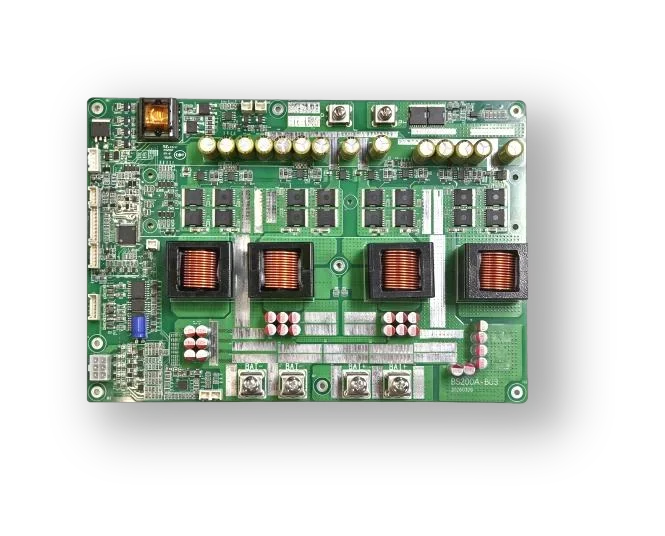
Develop battery monitoring, protection, power conversion and communication around your product requirements. The MS-BS200A family in Matsutake product materials provides a concrete example of this integrated engineering approach.
Product example
MS-BS200A boost BMS architecture
The documented 4S/5S LiFePO4 family combines battery management with bidirectional DC-DC conversion. The engineering scope includes voltage and current sensing, temperature monitoring, protection logic, active balancing and RS485/CAN communication.
Start with the cell configuration, charge/discharge profile, output requirements and host-system interfaces. Our engineers use these inputs to define the electrical design and validation work for your application.
Engineering inputs
Define the battery and the system together
| Input | What to specify | Why it matters |
|---|---|---|
| Cell configuration | Chemistry, series count and voltage envelope | Protection thresholds and power-stage architecture |
| Power profile | Continuous and transient charge/discharge loads | Thermal design, current sensing and protection response |
| System interface | Voltage classes, connectors and host communication | Power conversion and integration requirements |
| Operating environment | Temperature, enclosure, vibration and cooling | Component selection and validation plan |
| Firmware | States, alarms, balancing and update requirements | Control logic, diagnostics and release management |
What you receive
Design work tied to validation and manufacturing
- Agreed schematic, PCB and firmware outputs
- Prototype bring-up findings and revision actions
- Functional-test requirements and interface definitions
- Manufacturing-release files and programming instructions
Published product materials establish the development example; final model ratings and operating conditions belong in the approved project specification.
How the functions connect
Battery management and bidirectional conversion on one board
- Sense
Measure the cell, current and temperature inputs used by the controller.
- Protect and balance
Apply battery protection and balancing behavior around the specified cells.
- Convert power
Use the bidirectional DC–DC stage to connect the battery and system voltage.
- Communicate
Exchange status and control information through the defined RS485 or CAN interface.
Functional overview of the MS-BS200A family shown in the product materials. It is not a wiring diagram or a substitute for the model-specific specification.
Engineering decisions
Questions that shape a BMS design
| Decision | Why it matters | Engineering output to define |
|---|---|---|
| Cell chemistry and series count | The voltage range and protection thresholds must match the cells | Cell limits, sensing and protection definition |
| Continuous and transient power | Power conversion and heating depend on the real load profile | Power-stage and thermal design assumptions |
| Host communication | The system must interpret states, alarms and commands correctly | Interface specification and diagnostic behavior |
| Production verification | A repeat build needs repeatable firmware, calibration and tests | Programming, calibration and functional-test package |
Start a conversation
Discuss a BMS engineering project
Tell us what you need to build or the question you would like to discuss. Our team will help define the next step.
We can sign a non-disclosure agreement before discussing sensitive designs. Your project information and files are handled confidentially.